
Culinary highlights at the World Cultural Festival
Held for the first time on a large scale at Thang Long Imperial Citadel, the World Culture Festival brought together the cultural beauty of dozens of countries. The food stalls created a "feast" of flavors. Among them, Hanoi cuisine was an unmissable highlight.
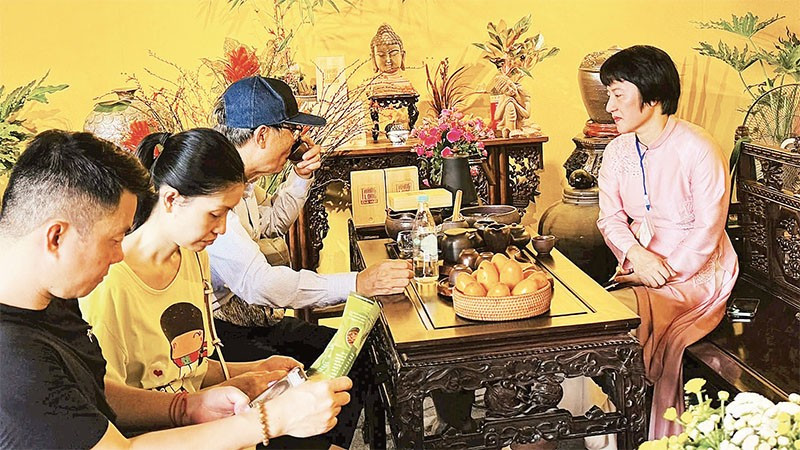
Introducing tea culture at the World Cultural Festival.
Over just three days of the weekend, approximately one million visitors flocked to Thang Long Imperial Citadel to participate in the activities of the World Culture Festival, organized by the Ministry of Culture, Sports and Tourism in coordination with the Ministry of Foreign Affairs and the People's Committee of Hanoi. Visitors experienced a vibrant festival atmosphere, with presentations on the cultures of countries from Asia to Europe and America, along with a series of cultural exchange activities, artistic performances, and unique cultural exhibitions.
The food court stands out amidst the festival space, attracting the most visitors. Stalls showcasing the unique cuisine of various countries are arranged side-by-side, creating a "food street" that transports visitors on a culinary journey across borders. Each stall is not only a place to enjoy food but also a space for cultural performances, where artisans introduce their cooking methods, share the stories behind their origins, and highlight the creative spirit behind each dish. Within this space, Hanoi cuisine becomes the focal point, honoring the traditional culinary values of the thousand-year-old capital city.
The food stalls are designed in an antique style, evoking memories of elegant Hanoi. One of the most attractive spaces is the Bat Trang cuisine section, featuring dishes recently recognized by the Ministry of Culture, Sports and Tourism as a National Intangible Cultural Heritage. Not only do they showcase the most distinctive dishes of Bat Trang, such as bamboo shoot and squid soup, stir-fried kohlrabi with squid, fried spring rolls, and sticky rice with sweet soup, but artisans from the ancient Bat Trang village also demonstrate the ingredients used to prepare these dishes, providing visitors with an enjoyable experience in a traditional culinary setting.
For a long time, green rice flakes (cốm) have not only been a gift from Hanoi but also a symbol of elegance in Thang Long culture, especially during autumn – Hanoi's most characteristic season. A representative of the Cốm Vân brand (from the Mễ Trì craft village) stated that the craft of making green rice flakes in Mễ Trì has been recognized as a National Intangible Cultural Heritage. The artisans are very proud to bring their hometown's product to the World Cultural Festival and hope that through the festival, international friends will understand and appreciate the traditional craft of making green rice flakes even more. Along with the elegance of green rice flakes is the West Lake lotus tea, a characteristic of meticulous preparation and enjoyment.
Mr. Le Duc Manh (a tourist from Thanh Hoa) said: “I visited Thang Long Imperial Citadel during the World Cultural Festival. I couldn't believe I could enjoy so many different dishes in one visit. I bought some Hanoi specialties as gifts for my family.”
Besides the dishes from Bat Trang, sticky rice flakes, and lotus tea, Hanoi's culinary scene is also captivating with dishes such as Thanh Tri rice rolls, Phu Thuong sticky rice, Uoc Le pork sausage, and Van Dinh roasted duck... Each dish tells a story about the culture and lifestyle of Hanoians, and each presentation tells a story about the way of life and thinking of Hanoians, past and present. Hanoi's cuisine is already famous. Through the Festival, Hanoi's dishes once again affirm their name on the national and international culinary map, thereby contributing to promoting tourism in particular and creating momentum for the development of the cultural industry in general.
Source: https://nhandan.vn/dau-an-am-thuc-trong-le-hoi-van-hoa-the-gioi-post915160.html